Coming on a Monday
Monday is the one day that quietly removes half of what you came for.
The Herbert, the Transport Museum, St Mary's Guildhall and the Music Museum are all normally closed on Mondays. If Coventry is a single day of a longer trip, a Monday visit means the cathedral, the market and Spon Street — and nothing else indoors.
Tuesday to Saturday is the safe window. Sunday works too, but with shorter hours: the cathedral opens at noon and closes at 3.30pm, and the Herbert only opens at noon.
Do this instead
Aim for Tuesday to Saturday, and put the museum you care about first. If Monday is the only day you have, build the day around the cathedral quarter, Broadgate and Spon Street — a good half day — and leave the museums for next time.
Seeing the ruins and walking away
The famous shell is not the whole cathedral. The best room is next door.
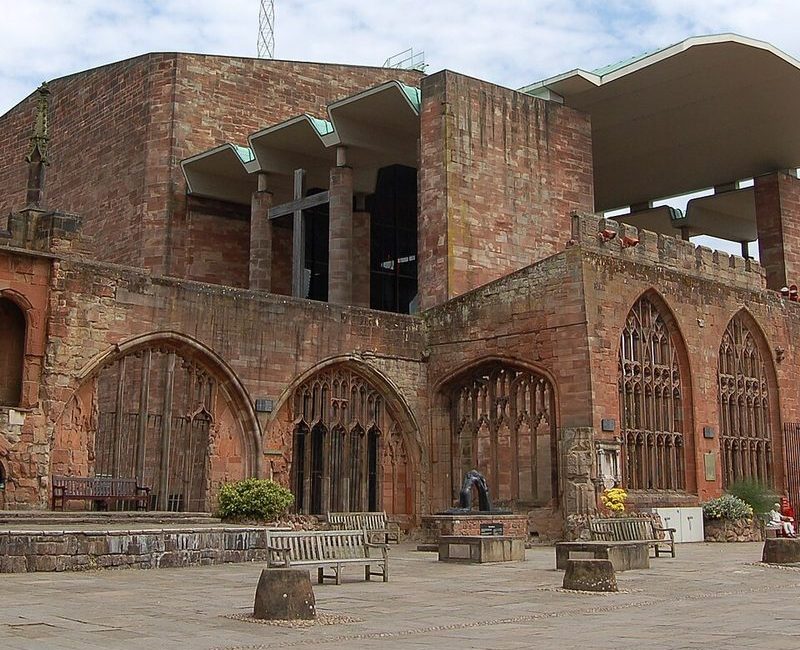
St Michael's was built between the late 14th and 15th centuries and destroyed in the raid of 14 November 1940. That night 568 people were killed and more than 4,300 homes were destroyed. The decision to keep the ruined walls, and to build beside them rather than over them, is the reason Coventry is worth the journey.
Basil Spence's New Cathedral was consecrated in 1962. Inside are Graham Sutherland's vast tapestry of Christ in Glory, the Cross of Nails, and a great south-facing window that is easy to miss because the nave pulls your eye the other way. Outside, on the ruins, is Jacob Epstein's St Michael and the Devil.
Many visitors photograph the shell from the pavement, assume that was it, and leave. They miss the sequence the building was designed around.
Do this instead
Enter the ruins from the Cuckoo Lane side, walk the shell first, then go through into the New Cathedral. Allow 90 minutes. Look for the charred cross, Epstein's sculpture, the great window, and the tapestry at the far end — then turn around and see how differently the nave reads from there.
“Free to enter, and easily the best two hours in the city.”
Driving into the middle of the city
The ring road is not dangerous. It is just unforgiving if you have never seen it.
Coventry's city centre sits inside a 2.25-mile dual carriageway with nine junctions. The junctions are close together — about 430 yards apart on average, with weaving gaps as short as 90 metres — and the signage assumes you already know which lane you need. Miss an exit and you have committed to another lap.
Then comes the second surprise: much of the centre is pedestrianised, and the walking routes cross the ring road through underpasses and bridges. A satnav that says “you have arrived” can leave you on the wrong side of six lanes.
Do this instead
Park once, outside the loop, and walk. For the cathedral quarter, Salt Lane car park (CV1 2GX) is about a quarter of a mile away; the cathedral has no visitor parking of its own. From Coventry station it is a 1.5-mile walk, roughly 25–30 minutes, or a short bus or taxi.
Getting off at Coventry Arena
There are two stations called Coventry. Only one is in Coventry city centre.
Coventry (COV) is the city-centre station, about 1.5 miles from the cathedral. Coventry Arena is roughly three miles north, next to the CBS Arena stadium and the retail park. It is useful on a match day and wrong for everything in this guide.
Trains from London Euston take as little as 54 minutes, with a typical journey around an hour. From Birmingham New Street it is roughly 20 to 30 minutes.
Do this instead
Check that your ticket says Coventry, not Coventry Arena. From the station, walk down Station Square and over the ring road deck into the centre — it is level and signed — or take a bus or taxi if you would rather save your legs.
Treating Coventry as a two-hour stop
It looks small on the map. The day fills up quickly.
The cathedral quarter alone takes two to three hours if you go inside both buildings. The Transport Museum is a solid two hours — it holds the two fastest cars ever built, Thrust SSC and Thrust 2. Spon Street is 45 minutes at an easy pace. Add lunch, and a four-hour visit is already tight.
People also try to bolt Coventry onto Stratford-upon-Avon or Birmingham in the same day. It can be done, but you will spend the day looking at your watch rather than at the city.
Do this instead
Give it a full day, or two if you want the museums without rushing. The plan further down this page fits everything into about seven hours, including a proper lunch.
Believing the concrete-city reputation
The post-war centre is real. So is the medieval city hiding inside it.
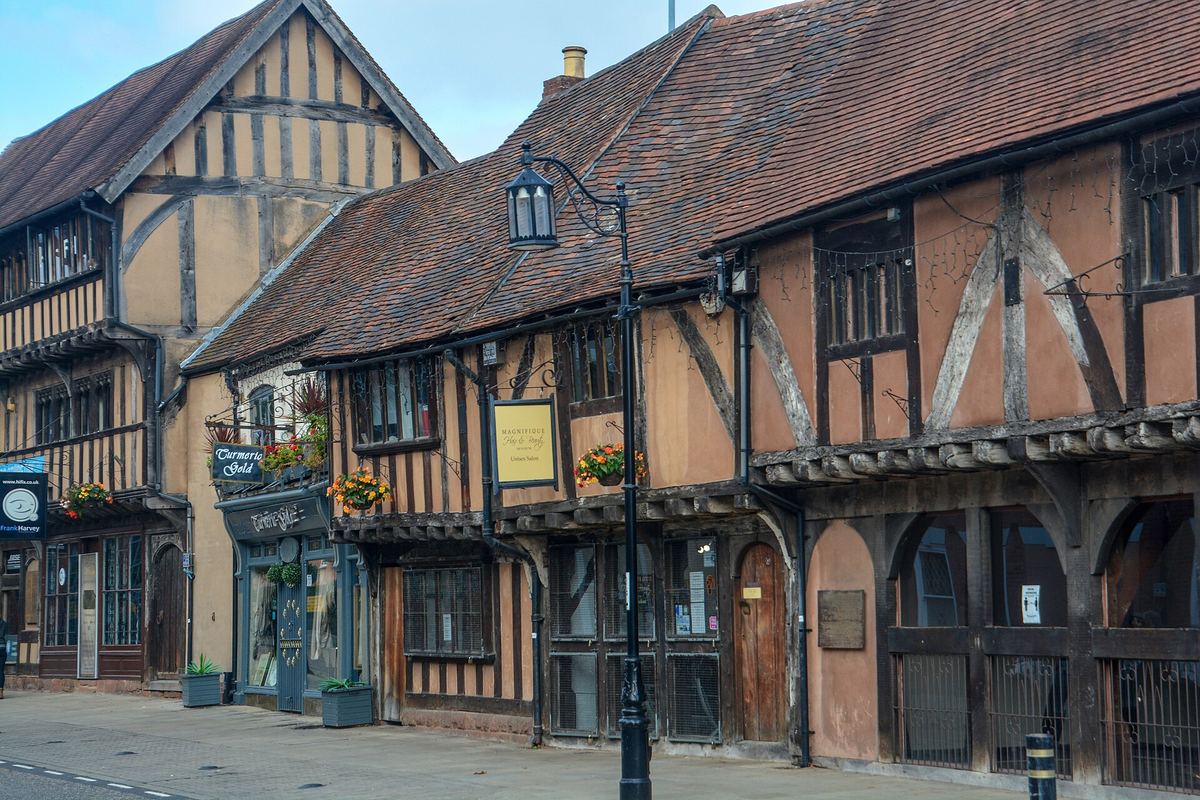
Coventry rebuilt fast after 1945, and the result is a lot of concrete. But the city still has 25 timber-framed buildings on Spon Street — 17 on their original sites, eight dismantled and re-erected there after the Blitz. It is one of the most important groups of its kind in England.
Two minutes from the cathedral, St Mary's Guildhall is a 14th-century survival with a medieval kitchen and a hall that has hosted royalty. Holy Trinity Church still has its spire. And the city's three spires — St Michael's, Holy Trinity and Christ Church — are the reason Coventry was nicknamed the city of three spires.
Do this instead
Walk Bayley Lane → Spon Street → FarGo Village. It takes about 90 minutes and passes the Guildhall, the Old Windmill pub and the timber fronts most day-trippers never see. If the Guildhall is open (Thursday to Sunday), go in.
Arriving at the market on Thursday afternoon or Sunday
The city's most useful lunch stop keeps unusual hours.
Coventry Market is the big circular hall on Queen Victoria Road, trading on the site since 1958. It is free to wander, good for a cheap lunch, and one of the few places where the city still feels like itself rather than a shopping centre.
But Thursday is a short day — it closes at 2.30pm — and Sunday is closed entirely. Individual stalls keep their own hours on top of that, so a late-afternoon visit can feel half-shut even when the doors are open.
Do this instead
Go Friday or Saturday morning, or before 2pm on Thursday. Monday to Wednesday is fine too, but the atmosphere is quieter. Do not plan a Sunday lunch here.
Photographing the cathedral at midday
The building is designed around light that arrives at a particular time.
The New Cathedral's great window faces south, not west, and the architects used it to control the whole sequence of the interior. Early in the day, sunlight comes straight through it and the glass is at its most colourful. By midday the nave is more evenly lit, but the window loses its punch and the contrast between the bright window and the dark interior becomes hard to balance.
The ruins are the opposite. They are open to the sky, and at midday the red sandstone gets flat, hard light with short shadows. Late afternoon rakes across the walls and gives the shell the depth people travel for.
Do this instead
Shoot the New Cathedral interior in the morning, ideally 9–11am, and the ruins from about 3pm — earlier in winter, when the sun drops fast. Overcast days are not a write-off: soft light suits the ruins and keeps the stonework readable.
It is a working church. No flash during services, and ask at the welcome desk before setting up a tripod.
Assuming you can climb the tower
The best view in Coventry is closed this year.
St Michael's tower survived the Blitz and stands more than 100 metres high, the third-tallest cathedral spire in England. The climb is 181 uneven spiral steps, and the reward is a 360-degree view over the city and the surrounding hills.
But the tower climb is closed for 2026, with reopening planned for 2027. It is also weather-dependent when it runs, and there is no lift.
Do this instead
Do not build the day around the climb. Check the cathedral's own site before you travel, and if it is shut, spend the time inside the New Cathedral instead — the interior is the better experience anyway. When it reopens, go early: the staircase is narrow and passing people is slow.
Skipping the music and the smaller museums
Coventry changed British music. Most visitors never find out.
Coventry gave the world 2-Tone: The Specials, The Selecter, and the label that put ska and punk in the same room. The Coventry Music Museum, in the 2-Tone Village on Walsgrave Road, tells that story properly — and yes, you can sit in the actual Ghost Town car. It also covers Delia Derbyshire, who arranged the Doctor Who theme, and a wider Coventry music history that goes back much further than 1979.
The museum is small, independent and only open Thursday to Sunday. That combination is why most itineraries miss it.
Do this instead
Pick one smaller place and protect the time for it: the Music Museum for music, the Herbert for art and the Lady Godiva story, St Mary's Guildhall for medieval architecture. All three are cheap, and all three are closed on Mondays.